
 TR:
:+17175469334
TR:
:+17175469334
Summary
Duration
15-30 minutes per implant
Recovery
1–3 days
Scarring
None
Sessions
2–3 sessions
Continuity of Results
15+ years
Length of Stay in Turkey
3–7 days

About Non-Surgical Dental Implant in Turkey
Non-surgical dental implants in Turkey refer to implant placement methods that minimize or eliminate incisions and sutures. Unlike the traditional approach where the gum is cut and peeled back (a flap) to expose the bone, a non-surgical (flapless) approach uses a small entry through the gum tissue. The implant is inserted directly through the gum without creating a large flap, often using a tissue punch or other minimally invasive tools. Advanced 3D imaging (such as cone-beam CT scans) and computer-guided planning are typically employed to ensure the implant is precisely positioned into the bone beneath, despite not having the bone directly visible during surgery.
By avoiding a traditional gum flap, these techniques offer several advantages. Because no large incision is made, patients usually do not require any stitches in the gum tissue. This preserves the surrounding gum and bone structure, maintaining better blood supply to the area and potentially reducing the risk of bone loss around the implant.
It also means minimal bleeding and swelling during and after the procedure, since the trauma to soft tissue is so limited. As a result, recovery tends to be faster – many patients can resume normal activities within a day or two. Importantly, “non-surgical” implant placement is still a precise surgical procedure (a small hole is drilled into the jawbone for the implant), so it requires meticulous planning and execution by an experienced implant dentist. But with modern technology and proper case selection, it provides a far more comfortable experience compared to traditional open surgery.
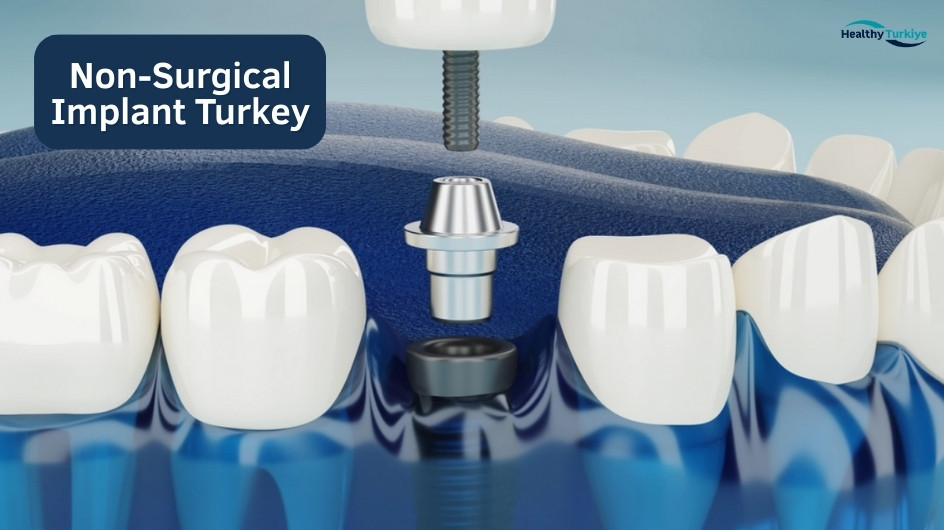
Non Surgical Implant in Turkey
Non-surgical dental implants in Turkey mean the implant is placed without making large incisions in the gums often using a flapless approach guided by advanced imaging. The implant still needs to be inserted into the jaw bone (so technically it is a minor surgical procedure), but by avoiding gum flaps and stitches, the procedure feels far less invasive. These results in shorter healing times, less discomfort, and a smoother recovery for patients.
Modern dental implantology has evolved to include “non-surgical” dental implant techniques that replace missing teeth with minimal invasiveness. In Turkey – a country renowned for cutting-edge dental care – many clinics in Istanbul, Antalya, Izmir and other cities have adopted these techniques to offer patients a gentler implant experience.

Who Is a Suitable Candidate?
Non-surgical dental implants can be an excellent option for many patients, but careful selection is essential. Ideal candidates typically have enough bone volume, healthy gums, and uncomplicated anatomy that allows implant placement without additional surgical procedures.
Adequate Bone Support: Patients should have sufficient bone height and width for stable implant placement. Severe bone loss or defects may require a traditional surgical approach or grafting. In some cases, digital planning can help bypass minor deficiencies.
Good Overall Health: Candidates should be medically stable. Uncontrolled diabetes or immune disorders may increase risks, but well-managed conditions can still be acceptable. Minimally invasive techniques are often safer for older adults or patients on blood thinners due to reduced bleeding and trauma.
Healthy Gums & No Infection: The area must be free of gum disease or active infection. Sufficient gum thickness is also important for long-term tissue stability.
Non-Smokers or Willing to Quit: Smoking impairs healing and increases implant failure risk. Patients are often advised to stop smoking before and after procedures.
Simpler Cases: Single implants or small gaps are ideal for flapless or guided techniques. More complex full-arch cases may require a hybrid or traditional approach.
Patients Seeking Fast Recovery: Those who prefer minimal downtime, have dental anxiety, or want a comfortable healing process often benefit from non-surgical methods, as swelling and pain are minimal.
Denture Wearers (Mini Implants): Mini implants placed flaplessly can stabilize dentures when sufficient bone remains.
Ultimately, a dentist will use clinical exams and 3D imaging to determine suitability. When candidates meet the criteria, flapless and guided implant techniques offer highly predictable, efficient, and comfortable treatment outcomes.
We Care About Your Health
Healthy Türkiye provides the best for your health and comfort. You will feel privileged with us.

7/24 Quality Personal Assistance Throughout Your Journey

Customizable for You All-Inclusive Packages

Get the Right Advice for your Health
Types of Non-Surgical Dental Implant Techniques in Turkey
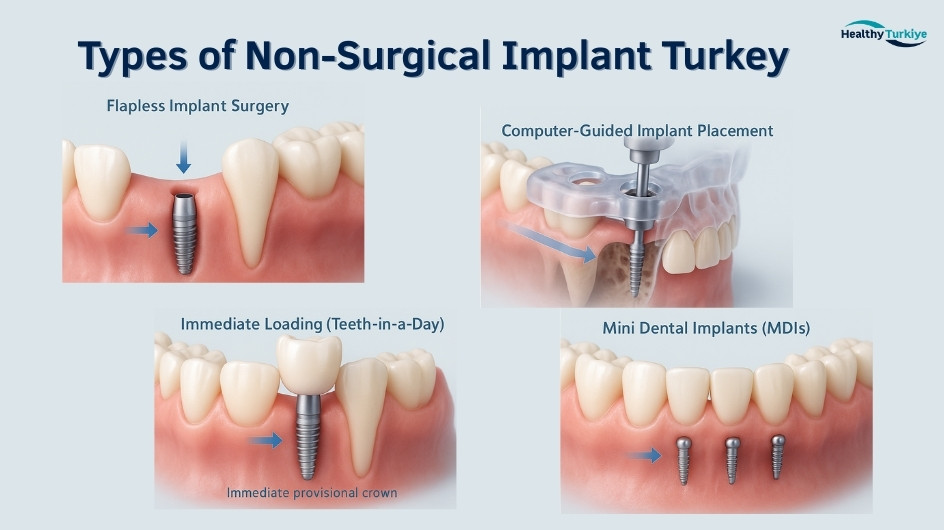
Several innovative techniques fall under the umbrella of non-surgical or minimally invasive dental implantation. These methods differ slightly in approach, but all aim to place implants with the least trauma possible. The main techniques include:
Flapless Implant Surgery in Turkey
This is the hallmark of non-surgical implant placement. In a flapless procedure, the dentist does not cut a large gum flap. Instead, a small circular incision or punch is made in the gum at the implant site. The implant is then inserted through this tiny opening directly into the bone. Because no flap is reflected, there is no need for stitches afterward.
Flapless surgery relies heavily on pre-operative imaging and planning – typically a 3D CT scan – to locate the ideal implant position and avoid vital structures, since the bone itself isn’t exposed during surgery. When done correctly, flapless implant insertion can be very accurate and greatly reduce patient discomfort.
This technique is often used for single implants or straightforward cases with adequate bone. It preserves soft tissue and promotes faster healing, but it does require that the surgeon know the bone anatomy in advance via scans.
Computer-Guided Implant Placement Turkey
In many cases, flapless surgery is combined with computer-guided implantology for maximum precision. Guided implant surgery uses advanced software to plan the implant virtually in a 3D model of the patient’s jaw. The dentist takes a cone-beam CT scan and digital impressions or scans of the patient’s mouth. These data are merged in planning software, allowing the dentist to “see” the exact bone structure, the gum thickness, and even map critical structures like the inferior alveolar nerve in the jaw.
The ideal implant position, angle, and depth are decided on the computer. Then a custom surgical guide (a rigid template) is fabricated, often by 3D printing. During the procedure, this guide fits over the patient’s teeth or gums and has pre-made holes that direct the drill and implant into the precise planned location. This approach enables the implant to be placed through a very small opening in the gum with millimeter-level accuracy.
Guided implant surgery thus complements the flapless technique: it compensates for the limited direct view by providing a roadmap, ensuring the implant avoids adjacent teeth roots, nerves, or sinus cavities. The result is a faster, highly predictable, and safe placement of the implant through a minimally invasive access. Many clinics call this “keyhole” implant surgery. Using computer-guided flapless methods, an implant can often be placed in a matter of minutes through a tiny punch in the gum, with little to no pain reported by patients.
Immediate Loading Protocols (Teeth-in-a-Day) in Turkey
Traditionally, after an implant is placed, dentists wait 2–3 months (or longer) for the bone to fully heal around it (osseointegration) before attaching a tooth on top. Immediate loading is a modern protocol where a temporary tooth or crown is placed on the implant the same day or within 48 hours of the implant surgery. In effect, the patient can walk out of surgery with a new tooth already in place (“teeth in a day”).
This does not mean the healing is instant, but rather that a provisional crown is fixed to the implant right away. For immediate loading to be successful, certain conditions must be met: the implant must achieve high primary stability (it should be very solidly anchored in the bone at placement) and the bite on the temporary crown must be adjusted to prevent heavy chewing forces initially. When those criteria are satisfied, studies show that immediate-loaded implants can have success rates comparable to traditional delayed loading, often around 97–100% after several years.
The benefit is a greatly shortened treatment timeline and improved aesthetics and function during healing – patients don’t have to go without teeth or wear removable dentures during the integration period. Immediate loading is often combined with flapless, guided surgery in full-arch cases (for example, in All-on-4 implants, where an entire arch of teeth is fixed on 4 implants in one day). By using precise surgical guides and in-house milling of a temporary prosthesis, Turkish clinics can frequently provide a one-day implant and temporary crown service. This approach minimizes the number of surgical sessions and maximizes patient convenience, though careful case selection is critical to ensure the implants are stable enough for loading.
Mini Dental Implants (MDIs) in Turkey
Another minimally invasive option sometimes discussed alongside non-surgical techniques is the use of mini implants. These are essentially smaller-diameter implants (often less than 3 mm in width) that can often be placed without extensive surgery. Because they are narrow, they require only a small pilot hole in the bone and typically a minor tissue punch in the gum (no large flap).
Mini implants were originally developed for situations with limited bone volume or to stabilize loose dentures. They are less invasive and cause minimal tissue trauma, which makes the procedure quick and the healing very fast. However, mini implants are generally used in specific cases (like supporting a denture or temporary support) and may not be a full replacement for standard implants when it comes to single-tooth replacements in areas of heavy bite force. In Turkish clinics, MDIs are available especially for patients who have an otherwise non-surgical treatment plan but lack enough bone for a full-size implant and do not want bone grafting. They exemplify the same principle of less cutting and quicker recovery.
Each of these techniques can be employed depending on the patient’s needs. Often, they are used in combination – for instance, a guided flapless surgery with immediate loading of a temporary crown. The overarching goal is to make implant treatment as minimally invasive and efficient as possible without compromising success. The best technique (or combination) is determined by the dentist after evaluating the patient’s oral condition, bone quality, and treatment goals.
Treatment Process and Clinical Protocols
In modern clinics, the non-surgical dental implant Turkey process begins with detailed digital planning. A CBCT scan and intraoral digital impressions are used to create a 3D model of the patient’s mouth. This data allows the dentist to determine the exact position, angle, and depth of the implant. When needed, a custom surgical guide is quickly produced on-site using 3D printing.
On the day of the procedure, local anesthesia is administered. With the flapless technique, only a small opening is made in the gum, eliminating incisions and stitches. Using the guide or a freehand method, the implant site is prepared and the implant is placed within minutes. A healing cap is attached, and the area typically shows only a tiny entry point.
If conditions are suitable, a temporary crown or bridge may be placed the same day. Otherwise, the implant is left to heal for several weeks to months. Soft tissue usually heals in 1–2 days, and most patients report minimal discomfort.
Once osseointegration is complete, the final step involves placing the abutment and fitting a custom-made porcelain or zirconia crown. Many clinics in Turkey streamline planning, guide fabrication, surgery, and restoration in one coordinated workflow, allowing for a faster, predictable, and comfortable treatment experience.
Benefits of Non-Surgical Implant Techniques in Turkey
Non-surgical implant methods provide major advantages for patients and clinicians due to their minimally invasive nature and digital precision.
Less Trauma & Faster Healing: Because no large gum flap is opened, the blood supply is preserved, healing is quicker, and inflammation is reduced. Patients typically return to normal activities within 24–48 hours and report significantly less pain, swelling, and need for medication compared to traditional surgery.
No Stitches & Minimal Bleeding: With only a small punch opening in the gum, no sutures are required and bleeding is very minimal. This creates a clean surgical environment and is especially helpful for patients who take blood thinners.
Lower Infection Risk: Since the gum isn’t widely opened, there is a smaller entry point for bacteria, resulting in cleaner and more predictable healing.
High Precision & Predictable Results: Digital planning and guided surgery allow implants to be placed exactly where intended, improving stability, prosthetic alignment, and long-term success. Many studies show flapless guided implants achieve success rates of 95–99%, comparable to conventional surgery.
Greater Patient Comfort: The procedure is quick, done under local anesthesia, and often feels no more invasive than a simple dental filling. Recovery is smoother with less soreness and no irritation from stitches, making it ideal for anxious patients.
Fewer Visits & Faster Treatment: With one-stage or immediate-loading protocols, patients can receive an implant and temporary crown on the same day. The absence of sutures and second-stage surgeries also reduces follow-up appointments.
Tissue Preservation: Avoiding a flap helps maintain blood supply and may reduce short-term bone loss around the implant, preserving soft tissue contours.
In summary, non-surgical implant placement offers quicker recovery, less discomfort, and predictable outcomes when performed by skilled clinicians. While not suitable for every case, it provides significant advantages for most straightforward implant treatments.
2026 Cost of Non-Surgical Dental Implant in Turkey
All types of medical attentions like non-surgical dental implant are very affordable in Turkey. Many factors are also included in determining the cost of non-surgical dental implant in Turkey. Your process with Healthy Türkiye will last from the time you decide to have a non-surgical dental implant in Turkey until the time you are fully recovered even if you are back home. The exact non-surgical dental implant procedure cost in Turkey depends on the type of operation involved.
The cost of non-surgical dental implant in Turkey does not demonstrate many variations in 2026. Compared to costs in developed countries like the United States or the UK, non-surgical dental implant costs in Turkey are relatively low. So, it's no wonder patients from across the world visit Turkey for non-surgical dental implant procedures. However, the price is not the only factor affecting choices. We suggest looking for hospitals that are safe and have non-surgical dental implant reviews on Google. When people decide to seek medical help for non-surgical dental implant, they will not only have had low-cost procedures in Turkey, but also the safest and best treatment.
At clinics or hospitals contracted with Healthy Türkiye, patients will receive the best non-surgical dental implant from specialist doctors in Turkey at affordable rates. Healthy Türkiye teams provide medical attention non-surgical dental implant procedures and high-quality treatment to patients at a minimum cost. When you contact Healthy Türkiye assistants, you can get free information about the cost of non-surgical dental implant in Turkey and what this cost covers.
The prices may vary based on specific procedure requirements. Contact us for exact price information.
Why Is Non-Surgical Dental Implant Cheaper in Turkey?
One of the main considerations before traveling abroad for non-surgical dental implant is the cost-effectiveness of the whole process. Many patients think that when they add flight tickets and hotel expenses to their non-surgical dental implant costs, it will become very expensive to travel, which is not true. Contrary to popular belief, round-trip flight tickets to Turkey for non-surgical dental implant can be booked very affordably.
In this case, assuming you are staying in Turkey for your non-surgical dental implant, your total travel expense of flight tickets and accommodation will only cost less than any other developed country, which is nothing compared to the amount that you are saving.
The question “why non-surgical dental implant cheaper in Turkey?” is so common between patients or people simply curious about getting their medical treatment in Turkey. When it comes to non-surgical dental implant prices in Turkey, there are 3 factors allowing cheaper prices:
The currency exchange is favorable for whoever looking for non-surgical dental implant has a euro, dollar, or pound;
The lower cost of living and cheaper overall medical expenses such as non-surgical dental implant;
For non-surgical dental implant, incentives are given by the Turkish Government to medical clinics working with international clients;
All these factors allow for cheaper non-surgical dental implant prices, but let’s be clear, these prices are cheaper for people with strong currencies (as we said, euro, dollar, Canadian dollar, pound, etc).
Every year, thousands of patients from all over the world come to Turkey to get non-surgical dental implant. The success of the healthcare system has increased in recent years, especially for non-surgical dental implant. It’s easy to find well-educated and English-speaking medical professionals in Turkey for all kinds of medical treatment such as non-surgical dental implant.
Why Choose Turkey for Non-Surgical Dental Implant?
Turkey is a common choice among international patients seeking advanced non-surgical dental implant. Turkey’s health procedures are safe and effective operations with a high success rate like non-surgical dental implant. The increasing demand for high-quality non-surgical dental implants at affordable prices has made Turkey a popular medical travel destination. In Turkey, non-surgical dental implant is performed by highly experienced and trained doctors with the most advanced technology in the world. non-surgical dental implant is done in Istanbul, Ankara, Antalya, and other major cities. The reasons for choosing non-surgical dental implant in Turkey are as follows:
High-quality hospitals: Joint Commission International (JCI) accredited hospitals have dedicated non-surgical dental implant units that are specially designed for patients. International and national strict protocols provide effective and successful non-surgical dental implant for patients in Turkey.
Qualified experts: The expert teams include nurses and specialist doctors, together to carry out non-surgical dental implant according to the patient's needs. All the included doctors are highly experienced in performing non-surgical dental implant.
Affordable price: The cost of non-surgical dental implant in Turkey is affordable compared to Europe, the USA, the UK, Singapore, Australia, etc.
The high success rate: Highly experienced specialists, the best available technology, and stringently followed safety guidelines for post-operative care of the patient, resulting in a high success rate for non-surgical dental implant in Turkey.
Is Non-Surgical Dental Implant Safe in Turkey?
Did you know Turkey is one of the most visited destinations for non-surgical dental implant in the world? It is ranked one of the most visited tourist destinations for non-surgical dental implant. Over the years it has also come to be a very popular medical tourism destination too with many tourists coming in for non-surgical dental implant. There are so many reasons why Turkey stands out as a leading destination for non-surgical dental implant. Because Turkey is both safe and easy to travel to too with a regional airport hub and flight connections to pretty much everywhere, it is preferred for non-surgical dental implant.
The best hospitals in Turkey have experienced medical staff and specialists who have performed thousands of medical services such as non-surgical dental implant. All procedures and coordination related to non-surgical dental implant are controlled by the Ministry of Health in accordance with the law. Over many years, the greatest progress in medicine has been observed in the field of non-surgical dental implant. Turkey is known among foreign patients for its great opportunities in the area of non-surgical dental implant.
To emphasize, besides the price itself, the key factor in selecting a destination for non-surgical dental implant is certainly the standard of medical services, the hospital staff’s high expertise, hospitality, and the safety of the country.
All-Inclusive Package for Non-Surgical Dental Implant in Turkey
Healthy Türkiye offers all-inclusive packages for non-surgical dental implant in Turkey at much lower prices. Extremely professional and experienced doctors and technicians carry out the high-quality non-surgical dental implant. The cost of non-surgical dental implant in European countries can be quite expensive, especially in the UK. Healthy Türkiye provides cheap all-inclusive packages for a long and short stay of non-surgical dental implant in Turkey. Because of many factors, we can provide you with many opportunities for your non-surgical dental implant in Turkey.
The price of non-surgical dental implant differs from other countries due to medical fees, staff labor prices, exchange rates, and market competition. You can save much more in non-surgical dental implant compared to other countries in Turkey. When you purchase non-surgical dental implant all-inclusive package with Healthy Türkiye our healthcare team will present of hotels for you to choose from. In non-surgical dental implant travel, you will have the price of your stay included in the all-inclusive package cost.
In Turkey, when you purchase non-surgical dental implant all-inclusive packages through Healthy Türkiye, you will always receive VIP transfers. These are provided by Healthy Türkiye, which is contracted with highly qualified hospitals for non-surgical dental implant in Turkey. Healthy Türkiye teams will organize everything about non-surgical dental implant for you and have you picked up from the airport and safely brought to your accommodation. Once settled in the hotel, you will be transferred to and from the clinic or hospital for non-surgical dental implant. After your non-surgical dental implant has been successfully completed, the transfer team will return you to the airport in time for your flight home. In Turkey, all packages of non-surgical dental implant can be arranged upon request, which relaxes the minds of our patients. You can reach out to Healthy Türkiye for everything you need to know about non-surgical dental implant in Turkey.
This article detailing "Non-Surgical Dental Implants in Turkey" has been prepared by Healthy Türkiye doctors, and its content validity and up-to-dateness were last reviewed and approved by Dr. Emre Aksu.
Frequently Asked Questions
In most cases yes, because guided placement ensures precise angulation and depth without opening the gum.
Only if the socket has enough intact bone walls and primary stability can be achieved; otherwise, a staged approach is safer.
Yes. Very thin gum tissue may require soft-tissue augmentation, otherwise long-term aesthetics and stability may be affected.
Yes, but only when bone volume and anatomy are ideal; many surgeons still combine flapless and minimal-flap techniques in full-arch cases.
Studies suggest it may help preserve crestal bone by maintaining periosteal blood supply, though results vary by patient and technique.