
 TR:
:+17175469334
TR:
:+17175469334
How do 3 on 6 dental implants work step by step is an important question for patients who want a fixed, stable, and natural-looking solution for full mouth restoration in Turkey.
Summary
- What Is the 3 on 6 Dental Implant System?
- Step-by-Step 3 on 6 Dental Implants Process
- Step 1: Online Consultation and Initial Evaluation
- Step 2: Clinical Examination and 3D Imaging in Turkey
- Step 3: Personalized Treatment Planning
- Step 4: Tooth Extraction and Pre-Surgical Preparation
- Step 5: Implant Surgery and Placement of Six Implants
- Step 6: Temporary Teeth or Temporary Restoration
- Step 7: Healing and Osseointegration Phase
- Step 8: Final Bridge Design and Material Selection
- Step 9: Placement of the Final 3 Bridges
- Step 10: Final Check, Aftercare, and Maintenance
- How Long Does the 3 on 6 Dental Implant Process Take?
- 3 on 6 Dental Implants vs Other Full Mouth Implant Systems
- Recovery After 3 on 6 Dental Implants
- Common Questions About How 3 on 6 Dental Implants Work
.jpg)
How Do 3 on 6 Dental Implants Work? Step-by-Step
3 on 6 dental implants in Turkey are an advanced full arch restoration system designed for patients who want fixed teeth with strong support, natural function, and long-term stability. Unlike removable dentures or single-piece full arch prostheses, the 3 on 6 technique uses six implants to support three separate bridges. This structure helps create a more natural bite, better force distribution, and improved hygiene compared to some traditional full mouth restoration options.
Understanding how 3 on 6 dental implants work step by step is essential for patients who are planning treatment abroad. Since this is a multi-stage procedure, patients usually want to know what happens before surgery, how implants are placed, how long healing takes, and when the final teeth are fitted. A clear explanation of the process helps reduce uncertainty and allows patients to approach the treatment with realistic expectations.
In Turkey, 3 on 6 dental implant treatments are usually planned through a structured and coordinated process. Clinics use advanced imaging, digital planning, and personalized treatment strategies to ensure that each stage is performed safely and efficiently. This organized approach is especially important for international patients who need a clear timeline and a well-managed treatment journey.
What Is the 3 on 6 Dental Implant System?
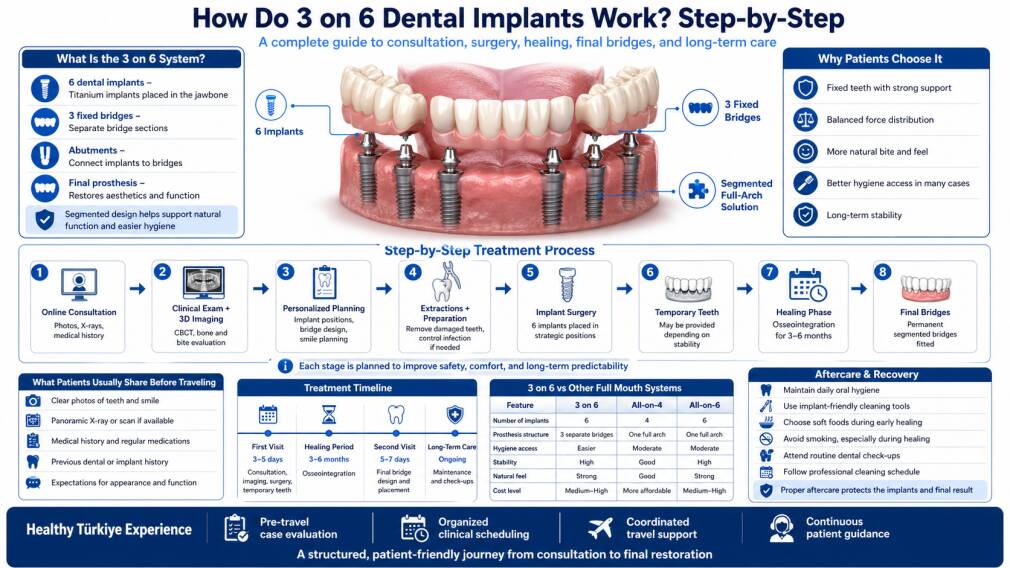
The 3 on 6 dental implant system is a full arch restoration method that uses six dental implants to support three fixed dental bridges. Each bridge is supported by two implants, creating a segmented structure instead of one continuous prosthetic arch. This design is one of the main features that makes the 3 on 6 technique different from other full mouth implant systems.
The segmented bridge structure allows the final restoration to function more like natural teeth. Instead of relying on one full prosthetic piece, the three bridge sections distribute chewing forces across the jaw in a more balanced way. This can improve comfort, stability, and long-term performance when the case is properly planned.
Another important feature of the 3 on 6 system is hygiene. Since the restoration is divided into separate sections, it may be easier to clean around the bridges compared to some full arch prostheses. This is important because long-term implant success depends not only on surgical placement but also on daily maintenance and professional follow-up.
Basic Structure of 3 on 6 Dental Implants
| Component | Description | Main Purpose |
|---|---|---|
| 6 dental implants | Titanium implants placed in the jawbone | Create strong support |
| 3 fixed bridges | Separate bridge sections attached to implants | Restore teeth and bite |
| Abutments | Connect implants to bridges | Provide stability |
| Final prosthesis | Custom-designed fixed teeth | Restore aesthetics and function |
This structure allows the 3 on 6 system to provide a fixed, functional, and natural-looking solution. For suitable patients, it can be a strong alternative to removable dentures and certain full arch implant systems.
Step-by-Step 3 on 6 Dental Implants Process
The 3 on 6 dental implants process is not completed in one single appointment. It follows a structured sequence that includes evaluation, planning, surgery, healing, and final bridge placement. Each stage has a specific purpose, and skipping or rushing any step can affect the long-term success of the treatment.
Patients often choose Turkey for this treatment because the process is efficiently organized for international cases. Before arrival, the clinic can review dental photos, X-rays, and medical information to prepare an initial plan. After arrival, detailed imaging and clinical evaluation are performed to confirm the final treatment approach.
The step-by-step structure also makes the journey easier for patients to understand. Instead of facing an unclear process, patients know when surgery will happen, how long healing will take, and when the final bridges will be placed. This clarity is one of the most important parts of a successful patient experience.
Step 1: Online Consultation and Initial Evaluation
The first step usually begins before the patient travels to Turkey. During the online consultation, patients share clear dental photos, medical history, previous dental records, and available X-rays if they have them. This allows the dental team to perform an initial review and understand the patient’s current oral condition.
At this stage, the dentist evaluates whether the patient may be suitable for 3 on 6 dental implants. Important factors include the number of missing teeth, gum condition, bone level, bite structure, and overall health. Although this online evaluation does not replace an in-person clinical examination, it provides a useful starting point for planning.
The initial evaluation also helps patients understand the possible treatment timeline and general requirements. If the case appears suitable, the clinic can prepare a preliminary plan and explain whether the patient may need extractions, bone grafting, or additional dental procedures. This helps avoid surprises after arrival and gives the patient more confidence before traveling.
What Patients Usually Share Before Traveling
- Clear photos of teeth and smile
- Panoramic X-ray or dental scans if available
- Medical history and regular medications
- Previous implant or dental treatment history
- Expectations about final appearance and function
This early information allows the dental team to prepare more efficiently. It also helps the patient receive a more realistic explanation of the treatment before committing to travel.
Step 2: Clinical Examination and 3D Imaging in Turkey
Once the patient arrives in Turkey, the next stage is a detailed clinical examination. This is where the initial online plan is confirmed or adjusted based on real clinical findings. The dentist examines the gums, remaining teeth, bite relationship, jaw structure, and overall oral health.
Advanced imaging plays a central role in this stage. Clinics commonly use panoramic X-rays and 3D CBCT scans to evaluate the jawbone in detail. These images help the dentist understand bone density, bone volume, sinus position, nerve location, and the safest areas for implant placement.
This step is essential because the 3 on 6 system requires six implants to be placed in stable and strategically selected positions. If the bone structure is not suitable in certain areas, the dentist may adjust the plan or recommend additional procedures. A precise diagnosis at this stage improves safety, accuracy, and long-term predictability.
Key Clinical Data Evaluated
| Evaluation Area | Why It Matters |
|---|---|
| Bone density | Determines whether implants can be supported |
| Bone volume | Helps decide implant size and position |
| Nerve location | Prevents surgical complications |
| Sinus position | Important for upper jaw implant planning |
| Bite alignment | Supports proper bridge design |
| Gum health | Reduces risk of infection and implant problems |
After imaging, the dentist explains the findings and finalizes the treatment plan. This is also the stage where patients can ask questions about materials, timeline, temporary teeth, and final bridge options.
Step 3: Personalized Treatment Planning
Personalized treatment planning is one of the most important stages of the 3 on 6 dental implant process. Since every patient has a different jaw structure, bone condition, and aesthetic expectation, the treatment cannot be planned with a standard template. The dentist must design the implant positions and bridge structure according to the patient’s individual needs.
During this stage, the dental team decides where each implant will be placed and how the three bridges will be designed. The goal is to create a stable foundation that supports chewing forces evenly across the arch. This is especially important because the final restoration must function comfortably for daily eating, speaking, and smiling.
Aesthetic planning is also included in this phase. The shape, size, color, and alignment of the future teeth are planned according to the patient’s facial structure and smile line. This ensures that the final result does not look artificial or oversized but instead appears natural and balanced.
What the Treatment Plan Includes
- Number and position of implants
- Type of temporary restoration
- Final bridge material
- Smile design and tooth shade
- Need for extractions or bone grafting
- Surgical timeline and healing expectations
- Final prosthesis placement schedule
A well-prepared treatment plan gives both the patient and the dental team a clear roadmap. It also helps reduce risks because every stage is planned before the surgery begins.
Step 4: Tooth Extraction and Pre-Surgical Preparation
Some patients still have damaged, loose, or infected teeth before starting 3 on 6 dental implants. In these cases, tooth extraction may be necessary before or during the implant placement procedure. The dentist evaluates whether these teeth can be saved or whether removing them is the best option for long-term implant success.
Pre-surgical preparation may also include professional cleaning, gum treatment, or infection control. These steps are important because implants must be placed in a healthy oral environment. If active infection or untreated gum disease is present, it can increase the risk of complications during healing.
In some cases, extractions and implant placement can be performed in the same surgical session. In other cases, the dentist may recommend healing time before placing implants, especially if there is infection or severe bone loss. The decision depends on the patient’s clinical condition and the level of stability required.
Why Pre-Surgical Preparation Matters
Pre-surgical preparation helps create a safer and more predictable foundation for the implants. When the mouth is properly cleaned and infections are treated, the healing process becomes smoother. This stage may feel secondary, but it directly affects long-term success.
It also helps protect the final result. Aesthetic restoration is only successful when the biological foundation is healthy. For this reason, responsible clinics do not rush into implant surgery without first checking the condition of the gums, bone, and remaining teeth.
Step 5: Implant Surgery and Placement of Six Implants
The surgical phase is the core of the 3 on 6 dental implants process. During this stage, six titanium implants are placed into the jawbone according to the personalized treatment plan. These implants will later support the three fixed bridges that form the final restoration.
The procedure is performed under local anesthesia, and sedation may be used in suitable cases to increase patient comfort. Modern surgical techniques and digital planning help ensure that implants are placed at the correct angle, depth, and position. This precision is critical because the success of the final bridges depends on the stability of the implants.
Each implant is positioned to support balanced force distribution. Since the 3 on 6 system uses three separate bridges, implant placement must be planned carefully to support each bridge section properly. This is why imaging, planning, and surgical expertise are all essential parts of the process.
Implant Placement Overview
| Implant Placement Area | Purpose |
|---|---|
| Front section | Supports anterior bridge and smile aesthetics |
| Middle section | Helps distribute chewing forces |
| Back section | Provides posterior support and bite stability |
After implants are placed, the dentist checks primary stability. Primary stability refers to how firmly the implant is seated in the bone immediately after placement. Good primary stability is important for healing and, in some cases, for temporary teeth.
Step 6: Temporary Teeth or Temporary Restoration
After implant surgery, patients may receive temporary teeth depending on their case and implant stability. Temporary restorations are designed to provide appearance and basic function during the healing period. They are not as strong as the final bridges, but they help patients avoid being without teeth.
Temporary teeth are especially important for international patients because they improve comfort and confidence after surgery. Patients can smile, speak, and function more comfortably while waiting for the implants to integrate with the bone. However, it is important to understand that temporary teeth require careful use.
During this stage, patients are usually advised to follow a soft diet and avoid hard foods. The implants are still healing, and excessive pressure can interfere with osseointegration. Temporary teeth are part of the transition process, not the final result.
What Temporary Teeth Provide
- Improved appearance during healing
- Basic chewing and speaking function
- Protection of the surgical area
- Better confidence during the waiting period
Temporary restorations help make the treatment journey easier. They also give patients a preview of their future smile, although the final bridges will be stronger, more refined, and more durable.
Step 7: Healing and Osseointegration Phase
After surgery, the implants need time to integrate with the jawbone. This biological process is called osseointegration. During osseointegration, the bone gradually bonds with the surface of the titanium implants, creating a stable foundation for the final bridges.
This healing phase usually takes between 3 to 6 months, depending on the patient’s bone quality, general health, and aftercare compliance. Some patients heal faster, while others may require more time before final bridges can be safely placed. The dentist monitors this process through follow-up evaluations.
Patients must be careful during this period because the implants are still stabilizing. Good oral hygiene, soft diet, avoiding smoking, and attending follow-up appointments are essential. The success of the entire 3 on 6 treatment depends heavily on this healing stage.
What Happens During Osseointegration?
- Bone tissue attaches to the implant surface
- Implant stability increases over time
- Gum tissues heal around implant areas
- The foundation becomes ready for final bridges
- The bite and temporary restoration are monitored
This phase requires patience. Even though patients may already have temporary teeth, the final restoration should only be placed when the implants are stable enough to support long-term chewing forces.
Step 8: Final Bridge Design and Material Selection
Once the implants have fully integrated, the final bridge design process begins. This stage is where function and aesthetics come together. The dentist takes impressions or digital scans to create the final three bridges that will be attached to the six implants.
Material selection is one of the most important decisions at this stage. Zirconia is commonly preferred for its strength, durability, and natural appearance. Hybrid materials may also be used depending on the patient’s budget, bite condition, and clinical recommendation.
The final bridges are customized according to the patient’s mouth, facial features, and bite. The design must look natural but also function correctly. If the bite is not properly adjusted, it can create pressure points and affect long-term comfort.
Final Bridge Material Options
| Material | Main Advantage | Best For |
|---|---|---|
| Zirconia | High durability and natural aesthetics | Patients seeking premium results |
| Hybrid acrylic | Lighter and more affordable | Selected cases with budget focus |
| Ceramic-based options | Strong aesthetic appearance | Front smile zone focus |
The dentist explains the advantages and limitations of each material. The goal is to choose an option that matches the patient’s expectations, oral condition, and long-term needs.
Step 9: Placement of the Final 3 Bridges
The final placement stage is when the permanent bridges are attached to the implants. This is one of the most important moments in the treatment because it completes the transformation. The temporary restoration is removed, and the final bridges are carefully fitted.
During placement, the dentist checks the fit, bite, comfort, and appearance of the bridges. Small adjustments may be made to ensure that the teeth meet properly and feel natural when speaking or chewing. Proper bite adjustment is essential for protecting the implants and bridges over time.
Once everything is confirmed, the final bridges are secured to the implants. The patient leaves with fixed teeth that are designed for daily function and long-term use. This stage delivers the final aesthetic and functional result of the 3 on 6 dental implant process.
What Is Checked During Final Placement?
- Fit of each bridge section
- Bite alignment and chewing comfort
- Tooth shape, size, and color
- Gum line harmony
- Speech comfort
- Overall smile balance
Final placement is not only a technical step. It is also an aesthetic finishing stage. The goal is to create a smile that looks natural, feels comfortable, and supports daily function.
Step 10: Final Check, Aftercare, and Maintenance
After the final bridges are placed, the dentist performs a final check and explains aftercare instructions. Patients learn how to clean around the bridges, what foods to be careful with, and how often they should attend dental check-ups. This guidance is essential for protecting the implants and maintaining long-term results.
3 on 6 dental implants require consistent care, even though they are fixed restorations. Patients should brush regularly, use recommended cleaning tools, and avoid habits such as biting hard objects. Professional cleanings are also important because they help prevent plaque accumulation around implant areas.
Long-term success depends on both the quality of the treatment and the patient’s daily habits. When patients follow aftercare instructions properly, 3 on 6 dental implants can provide stable function and natural aesthetics for many years.
Key Aftercare Recommendations
- Maintain daily oral hygiene
- Use implant-friendly cleaning tools
- Avoid smoking, especially during healing
- Do not bite very hard objects
- Attend routine dental check-ups
- Follow the dentist’s professional cleaning schedule
Aftercare should be seen as part of the treatment, not something separate. Proper maintenance helps protect the investment and preserve the final result.
How Long Does the 3 on 6 Dental Implant Process Take?
The total treatment timeline depends on the patient’s oral condition, healing speed, and whether additional procedures are required. In most cases, the process is divided into two main visits. The first visit includes consultation, planning, surgery, and temporary restoration. The second visit takes place after healing and includes final bridge placement.
The healing phase between these visits usually takes 3 to 6 months. This time is necessary because implants must integrate with the bone before they can safely support the permanent bridges. Rushing this process can affect long-term success.
For international patients, Turkey offers an efficient and organized timeline. Appointments are usually planned in advance so the patient can complete each stage with minimal waiting time. This makes the process easier to manage for patients traveling from abroad.
3 on 6 Treatment Timeline Overview
| Phase | Estimated Duration | Main Purpose |
|---|---|---|
| First visit | 3–5 days | Consultation, imaging, surgery, temporary teeth |
| Healing period | 3–6 months | Osseointegration |
| Second visit | 5–7 days | Final bridge design and placement |
| Long-term care | Ongoing | Maintenance and check-ups |
This timeline gives patients a realistic expectation of the full journey. It also helps them plan travel, work schedules, and recovery time more effectively.
How Do 3 on 6 Dental Implants Feel After Treatment?
One of the main reasons patients choose 3 on 6 dental implants is the natural feeling they provide. Because the system uses fixed bridges supported by implants, patients do not experience the movement or instability often associated with removable dentures. This makes eating, speaking, and smiling feel more secure.
The segmented bridge structure can also contribute to a more natural sensation. Since the restoration is divided into three sections, it may feel less bulky than some single-piece full arch prostheses. This can improve comfort and make daily use easier.
However, patients should understand that there is an adaptation period. Even with a well-designed final restoration, the mouth needs time to adjust to the new teeth. Speech, bite comfort, and chewing confidence usually improve gradually as the patient gets used to the final bridges.
3 on 6 Dental Implants vs Other Full Mouth Implant Systems
Patients often compare 3 on 6 dental implants with All-on-4, All-on-6, and traditional implant systems. Each option has different advantages, and the best choice depends on bone condition, budget, expectations, and clinical suitability. The 3 on 6 system stands out because of its segmented bridge structure.
All-on-4 typically uses four implants to support one full arch prosthesis. This can be efficient and cost-effective, especially for patients with limited bone. All-on-6 uses six implants for additional stability but usually supports one full arch structure. 3 on 6, however, uses six implants with three separate bridges, which may provide better hygiene and a more natural distribution of forces.
The decision should always be based on a detailed clinical evaluation. A patient may prefer 3 on 6, but the dentist must confirm whether the bone structure and bite condition are suitable. The most successful treatment is the one that matches the patient’s anatomy and long-term needs.
Comparison Overview
| Feature | 3 on 6 | All-on-4 | All-on-6 |
|---|---|---|---|
| Number of implants | 6 | 4 | 6 |
| Prosthesis structure | 3 separate bridges | One full arch | One full arch |
| Hygiene access | Easier in many cases | Moderate | Moderate |
| Stability | High | Good | High |
| Natural feel | Strong | Good | Strong |
| Cost level | Medium–High | More affordable | Medium–High |
This comparison helps patients understand why 3 on 6 may be recommended in certain cases. It is especially valuable for patients who prioritize natural function, hygiene, and long-term performance.
Recovery After 3 on 6 Dental Implants
Recovery after 3 on 6 dental implants is a gradual process that begins immediately after surgery. Patients may experience swelling, mild discomfort, and sensitivity in the first few days. These symptoms are generally temporary and can be managed with medication and proper aftercare.
During the first weeks, the main priority is protecting the implants and allowing the gum tissues to heal. Patients should follow a soft diet and avoid putting excessive pressure on the implant areas. Good oral hygiene is also important, but cleaning must be performed gently according to the dentist’s instructions.
Recovery continues during the osseointegration phase. Although the patient may feel comfortable after the first few weeks, the implants are still bonding with the jawbone internally. This is why patients must continue following professional advice throughout the healing period.
Recovery Tips for Better Healing
- Choose soft foods during the early recovery stage
- Avoid smoking and alcohol during healing
- Keep the mouth clean without irritating surgical areas
- Follow prescribed medication instructions
- Avoid hard or sticky foods
- Attend scheduled check-ups
A smooth recovery depends on patient cooperation. Even the best surgical technique requires proper aftercare to achieve long-term success.
Common Questions About How 3 on 6 Dental Implants Work
Patients usually have several questions before choosing 3 on 6 dental implants in Turkey. These questions often focus on pain, treatment duration, temporary teeth, and long-term results. Answering them clearly helps patients feel more prepared.
Is the 3 on 6 Dental Implant Procedure Painful?
The procedure is performed under anesthesia, so patients should not feel pain during surgery. After the procedure, mild discomfort and swelling can occur, but these symptoms are usually manageable. Most patients describe the recovery as easier than they expected when they follow aftercare instructions.
Can Temporary Teeth Be Placed Immediately?
Temporary teeth may be placed shortly after surgery depending on implant stability and the patient’s case. The dentist decides whether immediate loading is safe. If temporary teeth are provided, patients must use them carefully during the healing period.
How Long Do 3 on 6 Dental Implants Last?
With proper planning, high-quality materials, and good aftercare, 3 on 6 dental implants can provide long-term results. The implants themselves can last many years, while the bridges may require maintenance or replacement over time. Regular check-ups are essential for protecting both implants and prosthetic structures.
Is 3 on 6 Suitable for Everyone?
Not every patient is automatically suitable for the 3 on 6 system. Patients need enough bone support for six implants and should have healthy gums or treatable oral conditions. A detailed clinical examination is required before confirming suitability.
Healthy Türkiye Step-by-Step Experience
Healthy Türkiye provides a coordinated treatment journey for patients considering 3 on 6 dental implants in Turkey. The process begins with online consultation and case evaluation, allowing the team to understand the patient’s dental needs before travel. This early stage helps create a preliminary plan and gives the patient a clearer idea of what to expect.
Once the patient arrives in Turkey, clinical examinations, imaging, and treatment planning are organized efficiently. Appointments are scheduled to reduce waiting time and ensure that each step progresses smoothly. This structure is especially valuable for international patients who need a clear and predictable timeline.
Throughout the treatment journey, patients receive support with communication, scheduling, and coordination. Travel-related elements such as accommodation and transfers can also be arranged depending on the package. This allows patients to focus on treatment and recovery while the process is managed professionally.
Final Thoughts
How do 3 on 6 dental implants work step by step is best understood as a structured journey rather than a single procedure. The process includes consultation, imaging, planning, surgery, healing, final bridge placement, and long-term maintenance. Each stage plays an important role in achieving stable, functional, and natural-looking results.
The 3 on 6 system offers a strong option for patients who want fixed teeth with improved stability and hygiene. Its use of six implants and three separate bridges makes it different from many other full arch solutions. For suitable patients, this can provide excellent comfort, durability, and aesthetic balance.
Turkey remains a preferred destination for 3 on 6 dental implants because of its advanced clinics, experienced specialists, and organized treatment systems. With proper planning and professional care, patients can achieve a reliable full mouth restoration that improves both oral function and quality of life.