
 TR:
:+17175469334
TR:
:+17175469334
All on 4 dental implants offer a structured and efficient step-by-step solution for full mouth restoration, combining advanced implant techniques with immediate and long-term results.
Summary
- What Is the All on 4 Dental Implant System?
-
Step-by-Step All on 4 Dental Implants Process
- Step 1: Online Consultation and Initial Evaluation
- Step 2: Detailed Clinical Examination and Imaging
- Step 3: Personalized Treatment Planning
- Step 4: Implant Surgery
- Surgical Placement Overview
- Step 5: Immediate Temporary Teeth Placement
- Step 6: Healing and Osseointegration Phase
- Step 7: Final Prosthesis Design and Placement
- How Long Does the Entire Process Take?
- What Makes All on 4 Different from Traditional Implants?
- Recovery and Aftercare Step by Step
- Common Questions About the Procedure
- Healthy Türkiye Step-by-Step Experience
.jpg)
How Do All on 4 Dental Implants Turkey Work? Step-by-Step
All on 4 dental implants in Turkey have become one of the most effective solutions for patients who need full mouth restoration. Unlike traditional implant systems, this method follows a carefully structured step-by-step process that allows patients to receive fixed teeth in a shorter timeframe with fewer implants.
Understanding how all on 4 dental implants turkey work step by step helps patients feel more confident and prepared before starting treatment. Each stage, from consultation to final prosthesis, is designed to ensure stability, functionality, and natural aesthetics.
What Is the All on 4 Dental Implant System?
Before exploring the step-by-step process, it is important to understand how the system works from a structural perspective.
All on 4 dental implants involve placing four titanium implants into the jawbone to support a full arch of fixed teeth. Two implants are positioned vertically at the front, while two are placed at an angle at the back. This angled placement increases bone contact and allows the system to function effectively even in cases of moderate bone loss.
This design reduces the need for bone grafting and simplifies the overall procedure, making it more accessible and efficient for patients.
Step-by-Step All on 4 Dental Implants Process
The All on 4 dental implants process is carefully structured into multiple stages, each designed to ensure precision, safety, and long-term success. Rather than being a single procedure, this treatment involves a coordinated sequence of evaluation, planning, surgical execution, and follow-up steps. Every phase builds on the previous one, allowing the dental team to achieve both functional stability and natural-looking results.
Understanding this step-by-step approach helps patients feel more confident and informed, especially when traveling for treatment. Each stage is planned to minimize risks, optimize outcomes, and ensure that the final prosthesis fits perfectly in terms of both aesthetics and function.
Step 1: Online Consultation and Initial Evaluation
The All on 4 dental implants process typically begins before the patient travels to Turkey. This initial stage is conducted remotely and plays a crucial role in determining whether the treatment is suitable for the patient.
During the online consultation, patients are asked to share clear photographs of their teeth and smile, along with any previous dental records, panoramic X-rays, or 3D scans if available. These materials allow the dental team to perform a preliminary assessment without requiring the patient to be physically present.
At this stage, the dentist evaluates several important factors, including the general condition of the teeth and gums, the level of tooth loss, and the potential need for full mouth restoration. Even though this is an initial review, it provides valuable insight into whether the patient is a good candidate for All on 4 dental implants.
This step also helps establish realistic expectations. The dental team may provide an overview of the possible treatment approach, estimated timeline, and general structure of the procedure. In many cases, a preliminary treatment plan is created, giving the patient a clear understanding of how their All on 4 dental implants journey will be organized.
Another important benefit of this stage is planning efficiency. By reviewing the case in advance, the clinic can prepare for the patient’s arrival, organize the necessary appointments, and ensure that the treatment process begins without delays.
Step 2: Detailed Clinical Examination and Imaging
Once the patient arrives in Turkey, the next stage involves a comprehensive clinical examination supported by advanced imaging technologies. This step is critical because it confirms and refines the initial assessment made during the online consultation.
The dentist performs a detailed oral examination, checking the condition of the gums, remaining teeth (if any), and overall oral health. However, the most important part of this stage is the use of digital imaging systems, such as panoramic X-rays and 3D cone beam computed tomography (CBCT) scans.
These imaging techniques provide highly detailed and accurate information about the patient’s anatomy, allowing the dentist to plan the procedure with precision.
Key Clinical Data Evaluated
- Bone density: Determines whether the jawbone can support implants
- Jaw structure: Identifies the shape and volume of the bone
- Nerve positioning: Helps avoid critical anatomical structures
- Sinus location (upper jaw): Important for safe implant placement
- Implant placement angles: Ensures optimal stability and support
This level of detailed analysis is essential for creating a safe and effective surgical plan. It allows the dentist to determine the exact position, angle, and depth of each implant, ensuring maximum contact with the available bone.
In addition to safety, this step directly impacts the final aesthetic outcome. Proper planning ensures that the implants will support a prosthesis that looks natural and aligns well with the patient’s facial structure.
At this stage, the initial treatment plan may be adjusted based on real clinical findings. The dentist finalizes decisions regarding implant positioning, prosthesis type, and the overall treatment strategy. This ensures that the procedure is fully customized to the patient’s needs, providing a strong foundation for the next stages of the All on 4 dental implants process.
Step 3: Personalized Treatment Planning
Based on the imaging results, the dentist creates a personalized treatment plan. This plan includes:
- Implant positioning
- Type of prosthesis
- Number of teeth in the arch
- Aesthetic design
The goal is to ensure that the final result is both functional and natural-looking.
Step 4: Implant Surgery
The surgical phase is the most critical part of the All on 4 dental implants process, as it forms the foundation for the entire treatment. During this stage, four titanium implants are carefully placed into the jawbone in predetermined positions based on detailed planning and imaging performed earlier. The success of the treatment largely depends on the precision and accuracy of this step.
The procedure is typically performed under local anesthesia, and in some cases, sedation may be used to increase patient comfort. Thanks to modern surgical techniques and digital planning, the operation is carried out in a highly controlled clinical environment, minimizing risks and ensuring predictable results.
What makes All on 4 unique is the strategic positioning of the implants. Instead of placing multiple implants vertically, this system uses a combination of straight and angled placements to maximize bone support and stability.
Surgical Placement Overview
| Implant Type | Position | Function |
|---|---|---|
| Anterior Implants | Front (vertical) | Primary stability |
| Posterior Implants | Back (angled) | Bone maximization |
The anterior implants are placed in the front region of the jaw, where bone density is typically higher. These implants provide strong initial support and play a key role in stabilizing the prosthesis.
The posterior implants, on the other hand, are placed at a specific angle in the back of the jaw. This angled placement allows the dentist to utilize available bone more effectively, often avoiding the need for bone grafting or sinus lift procedures. It also helps distribute chewing forces more evenly across the implants.
During the surgery, the dentist carefully prepares the implant sites, places the implants, and ensures that each one is positioned at the correct angle and depth. Precision is essential, as even small deviations can affect both function and aesthetics.
Although it is a surgical procedure, discomfort is usually minimal due to advanced techniques and proper anesthesia. Most patients report only mild swelling or sensitivity after the procedure, which typically subsides within a few days.
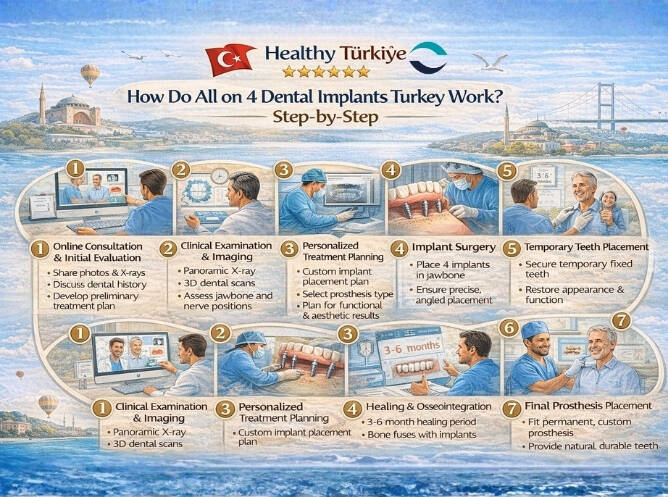
Step 5: Immediate Temporary Teeth Placement
One of the most significant advantages of All on 4 dental implants is the possibility of immediate loading, meaning temporary fixed teeth can be placed on the same day as the implant surgery. This is a major difference compared to traditional implant methods, where patients may need to wait months before receiving visible results.
After the implants are securely placed, a temporary prosthesis is attached. This temporary set of teeth is designed to provide both function and aesthetics during the healing period.
This means that patients leave the clinic with:
- Fixed temporary teeth that do not need to be removed
- A functional bite that allows basic eating and speaking
- An immediate improvement in smile aesthetics
This instant transformation has a strong psychological and emotional impact. Patients who previously struggled with missing teeth or unstable dentures can immediately regain confidence in their appearance and daily interactions.
The temporary teeth are carefully designed to be lightweight and to avoid excessive pressure on the implants during the healing phase. While they allow normal daily function, patients are usually advised to follow a softer diet and avoid hard foods until the implants are fully integrated with the bone.
This stage is not only about aesthetics but also about maintaining proper oral function and supporting the healing process. By stabilizing the implants and guiding the bite, the temporary prosthesis plays an important role in the overall success of the treatment.
Overall, the ability to provide immediate fixed teeth is one of the key reasons why All on 4 dental implants in Turkey are so widely preferred. It combines surgical efficiency with immediate results, offering patients both functional restoration and instant visual improvement.
Step 6: Healing and Osseointegration Phase
After the implant surgery and placement of temporary teeth, the treatment enters one of the most critical stages: the healing and osseointegration phase. This period is essential for the long-term success of All on 4 dental implants, as it determines how well the implants integrate with the jawbone.
Osseointegration is the biological process in which the jawbone gradually fuses with the surface of the titanium implants. Rather than simply holding the implants in place, the bone grows around them, creating a strong and stable connection that mimics the function of natural tooth roots. This integration transforms the implants into a permanent part of the oral structure.
This phase typically takes between 3 to 6 months, depending on factors such as bone quality, overall health, and adherence to aftercare instructions. During this time, the implants gain increasing stability, allowing them to support long-term functional loads such as chewing and speaking.
What Happens During Osseointegration?
- The bone tissue gradually grows and attaches to the implant surface
- Micromovements decrease as the implant becomes more stable
- The implant transitions from temporary support to a permanent foundation
- The overall strength of the system improves significantly
Although patients already have temporary fixed teeth during this phase, it is important to understand that the implants are still in the process of stabilizing. For this reason, certain precautions must be followed to protect the implants and ensure successful healing.
Key Aftercare Guidelines During Healing
- Follow a soft or controlled diet to avoid excessive pressure
- Maintain consistent oral hygiene to prevent infection
- Avoid smoking, as it can negatively affect bone healing
- Attend scheduled follow-up visits for monitoring
- Avoid habits such as grinding or biting hard objects
This stage requires patience and discipline, as proper healing directly impacts the durability and long-term performance of the implants. When managed correctly, osseointegration results in a strong and reliable foundation that can support the final prosthesis for many years.
Step 7: Final Prosthesis Design and Placement
Once the healing and osseointegration phase is successfully completed, the treatment moves into the final stage: designing and placing the permanent prosthesis. This is the stage where the functional and aesthetic transformation is fully finalized.
The temporary teeth used during the healing period are replaced with a custom-designed permanent prosthesis. Unlike temporary restorations, the final prosthesis is built for long-term durability, improved aesthetics, and enhanced comfort.
This stage begins with a detailed evaluation of the patient’s current condition. The dentist assesses implant stability, bite alignment, and overall oral function. Measurements and impressions are then taken to create a prosthesis that fits precisely and harmonizes with the patient’s facial features.
The design process focuses on several key elements:
- Tooth shape and size for natural appearance
- Color matching for realistic aesthetics
- Bite alignment for proper function
- Smile symmetry for overall balance
Final Prosthesis Options
| Type | Features |
|---|---|
| Hybrid (Acrylic) | Lightweight, cost-effective, functional |
| Zirconia | High strength, superior aesthetics, long-lasting |
Hybrid prostheses are typically more accessible and lighter, making them a practical option for many patients. Zirconia prostheses, on the other hand, offer a more premium solution with enhanced durability, stain resistance, and a highly natural appearance.
Once the prosthesis is fabricated, it is carefully placed onto the implants. The dentist performs detailed adjustments to ensure that the bite is comfortable and that the teeth align properly. Final polishing and refinements are made to achieve a smooth, natural finish.
The result is a permanent set of fixed teeth that:
- Look natural and aesthetically balanced
- Function like real teeth during eating and speaking
- Provide long-term stability and comfort
- Eliminate the need for removable dentures
This final stage completes the transformation, allowing patients to fully experience the benefits of All on 4 dental implants. With proper care and regular maintenance, the final prosthesis can provide a long-lasting and reliable solution, significantly improving both oral health and overall quality of life.
How Long Does the Entire Process Take?
The All on 4 treatment is typically completed in two main phases.
Timeline Overview
| Phase | Duration | Outcome |
|---|---|---|
| Initial Visit | 3–5 days | Surgery + temporary teeth |
| Healing Period | 3–6 months | Implant integration |
| Second Visit | 5–7 days | Final teeth placement |
This structured timeline allows patients to plan their treatment efficiently.
What Makes All on 4 Different from Traditional Implants?
All on 4 dental implants stand out from traditional implant systems due to their efficient design, reduced surgical complexity, and ability to deliver faster results. While both approaches aim to restore missing teeth, the methodology, treatment timeline, and overall patient experience differ significantly.
Traditional implant treatments are usually planned on a tooth-by-tooth or segment basis, which often requires placing multiple implants across the jaw. In contrast, the All on 4 concept is specifically designed for full arch restoration, using only four strategically positioned implants to support an entire set of teeth. This not only simplifies the procedure but also makes it more accessible for patients with varying bone conditions.
One of the most important differences lies in how the implants interact with the jawbone. Traditional systems often require vertical placement and sufficient bone volume, which may lead to additional procedures such as bone grafting or sinus lifting. The All on 4 technique, however, uses angled posterior implants to maximize existing bone, reducing or eliminating the need for these extra surgical steps.
Key Differences
| Feature | All on 4 | Traditional Implants |
|---|---|---|
| Number of Implants | 4 per jaw | 6–8 or more |
| Treatment Time | Shorter and structured | Longer and multi-stage |
| Bone Grafting | Often not required | Frequently required |
| Immediate Teeth | Yes, same-day temporary teeth | Rare, delayed loading |
| Procedure Complexity | Moderate | Higher |
| Patient Comfort | Higher | Moderate |
Another major advantage of All on 4 is the concept of immediate loading. Patients can receive temporary fixed teeth on the same day as surgery, which is rarely possible with traditional implant systems. This significantly improves both functionality and confidence during the treatment process.
From a practical perspective, All on 4 is particularly beneficial for patients seeking a faster and more efficient solution. Instead of undergoing multiple surgeries over an extended period, patients can complete the main stages of treatment within a shorter and more predictable timeline.
Overall, these differences make All on 4 dental implants a more streamlined and patient-friendly option, especially for full mouth restoration cases where efficiency, stability, and immediate results are important.
Recovery and Aftercare Step by Step
Recovery is a crucial phase in the All on 4 dental implants process, as it directly affects the long-term success and stability of the treatment. Although the procedure is designed to be efficient and minimally invasive compared to traditional methods, proper aftercare is essential to ensure successful healing and implant integration.
Immediately after surgery, patients may experience mild swelling, sensitivity, or discomfort, which are normal responses to the procedure. These symptoms are typically temporary and can be managed with prescribed medications and proper care.
The recovery process can be divided into two main stages: the initial healing period and the long-term maintenance phase.
Initial Healing Phase
During the first few weeks after surgery, the focus is on protecting the implants and allowing the surrounding tissues to heal properly. Patients are advised to follow specific guidelines to avoid complications and support the osseointegration process.
Aftercare Guidelines
- Follow a soft diet initially to minimize pressure on the implants
- Maintain consistent oral hygiene using recommended techniques
- Avoid smoking, as it can negatively affect healing and bone integration
- Attend scheduled follow-up appointments for monitoring progress
- Avoid excessive pressure, such as biting hard foods or grinding teeth
Adhering to these guidelines helps reduce the risk of complications and ensures that the implants remain stable during the critical healing phase.
Long-Term Maintenance Phase
Once the implants have fully integrated with the jawbone, patients can gradually return to a normal diet and routine. However, long-term care remains essential for maintaining the health of both the implants and surrounding tissues.
Patients are encouraged to maintain regular dental check-ups, professional cleanings, and good oral hygiene habits. Although All on 4 implants are designed for durability, proper maintenance helps extend their lifespan and preserve the aesthetic results.
Recovery Timeline Overview
| Stage | Duration | Focus |
|---|---|---|
| Initial Recovery | 1–2 weeks | Healing and comfort |
| Osseointegration | 3–6 months | Implant stability |
| Long-Term Care | Ongoing | Maintenance and durability |
Proper recovery and aftercare not only ensure the success of the implants but also contribute to overall patient satisfaction. When patients follow professional recommendations and maintain good oral hygiene, All on 4 dental implants can provide a stable, functional, and long-lasting solution for many years.
Common Questions About the Procedure
Is the All on 4 Dental Implant Procedure Painful?
Patients considering All on 4 dental implants in Turkey often have several important questions before making a decision. These questions usually focus on comfort, recovery time, treatment duration, and long-term results. Understanding these aspects in detail helps reduce uncertainty and allows patients to approach the procedure with greater confidence.
One of the most common concerns is whether the procedure is painful. Thanks to modern surgical techniques, advanced anesthesia methods, and precise planning, the procedure is generally well-tolerated. During the surgery, patients do not feel pain due to local anesthesia or sedation options. After the procedure, mild discomfort, swelling, or sensitivity may occur, but these symptoms are typically temporary and manageable with prescribed medication.
How Long Does Recovery Take After All on 4 Dental Implants?
Another frequently asked question relates to recovery time. Most patients are able to return to their daily routines within a few days, although some precautions are necessary during the initial healing phase. The presence of temporary fixed teeth allows patients to eat, speak, and smile comfortably shortly after the procedure, which significantly improves the overall experience.
How Long Does the Full All on 4 Treatment Process Take?
Patients also ask about the duration of the full treatment process. While the initial surgical phase and placement of temporary teeth are completed within a few days, the complete process—including final prosthesis placement—typically spans several months due to the healing and osseointegration phase. This timeline ensures that the implants integrate properly with the bone, providing long-term stability.
How Long Do All on 4 Dental Implants Last?
Other common questions include concerns about durability, maintenance, and suitability. Patients often want to know how long the implants will last and whether they require special care. With proper oral hygiene, regular check-ups, and adherence to professional recommendations, All on 4 implants can provide a long-lasting and reliable solution.
What Should Patients Expect During the Overall Process?
Overall, these questions highlight the importance of clear communication and detailed planning. When patients are fully informed about each stage of the procedure, they feel more comfortable and confident throughout their treatment journey.
Healthy Türkiye Step-by-Step Experience
Healthy Türkiye ensures that every stage of the All on 4 dental implants process is professionally organized and clearly structured for international patients. The goal is to create a seamless experience where patients do not have to manage complex details on their own.
From the very beginning, the process is guided by a coordinated system that focuses on clarity, efficiency, and patient comfort. Each step is carefully planned to ensure that the treatment progresses smoothly and without unnecessary delays.
Patient Journey
-
Online consultation
Patients begin by sharing their dental photos and medical information, allowing the dental team to perform an initial evaluation and determine suitability for treatment. -
Treatment planning
A personalized treatment plan is prepared based on the patient’s condition, expectations, and clinical findings. This plan includes a clear timeline and procedure details. -
Travel coordination
Healthy Türkiye assists with organizing travel arrangements, including accommodation and transfers, ensuring a comfortable and stress-free arrival. -
Surgery and follow-up
The surgical phase is carefully scheduled and performed by experienced specialists. After surgery, follow-up appointments are arranged to monitor healing and progress. -
Final restoration
Once the healing phase is complete, the final prosthesis is designed and placed, completing the transformation process.
This structured system allows patients to focus entirely on their treatment while every logistical and clinical detail is professionally managed. Continuous communication and support throughout the process further enhance patient confidence and comfort.
Final Thoughts
All on 4 dental implants in Turkey provide a highly structured, efficient, and reliable solution for full mouth restoration. Each stage of the process—from initial consultation to final prosthesis placement—is carefully designed to deliver both functional and aesthetic success.
What makes this treatment particularly effective is its ability to combine immediate results with long-term stability. Patients benefit from receiving fixed temporary teeth shortly after surgery, while the final prosthesis ensures durability and natural appearance over time.
Understanding how All on 4 dental implants work step by step allows patients to approach the process with realistic expectations and greater confidence. With proper planning, expert execution, and consistent aftercare, this dental treatment can significantly improve both oral health and overall quality of life.
For patients seeking a solution that is reliable, time-efficient, and aesthetically satisfying, All on 4 dental implants in Turkey represent a well-balanced and modern approach to full mouth restoration.